
Slavic spirituality as a cyclical system of life, death, and renewal.
Slavic spirituality is rooted in the rhythm of nature — everything moves in cycles and everything is connected with nature and with the spirits. The culture is very animistic and its moving in to the spiral and cycles . Life, death, and renewal aren’t seen as separate states, but as stages in a continuous circle. For the ancient Slavs, the divine wasn’t somewhere “above” but woven into the natural order itself. Every river, forest, and season reflected cosmic law.
The yearly cycle was the main spiritual text: spring marked birth, summer represented vitality, autumn symbolized decline and sacrifice, and winter meant death and gestation — the dark womb where life prepares to return. The gods mirrored these patterns: Perun ruled the height of summer storms, Veles reigned in the dark months beneath the earth. When one descended, the other rose — not as enemies, but as necessary polarity and eternal balance.
This worldview carries an implicit wisdom: decay is not an ending, but transformation. The fallen leaves become soil; ancestors become guardians; darkness becomes the seedbed of light. In this sense, Slavic spirituality doesn’t fear death — it honors it as the passage that keeps the world alive.
That cyclical understanding still whispers through rural customs today — in seasonal rituals, harvest feasts, and memorial days — reminding us that renewal is only possible because something has ended.
- November as the threshold between light and darkness, the living and the underworld.
In Slavic thought, November stands at the crossroads — the fading breath of autumn where daylight weakens and the shadows grow long. It is not simply “the eleventh month,” but a threshold month, a hinge between two realities: the living world above and the silent realm beneath.
As the sun retreats and the earth cools, life contracts inward. Nature itself performs a sacred drama of descent: sap sinks back into roots, animals burrow, fields fall silent. To the old Slavs, this wasn’t decay, but migration — the living crossing into the care of Veles, god of the underworld and wisdom. His domain was not a place of punishment, but a vast, fertile darkness where souls rested and the future germinated.
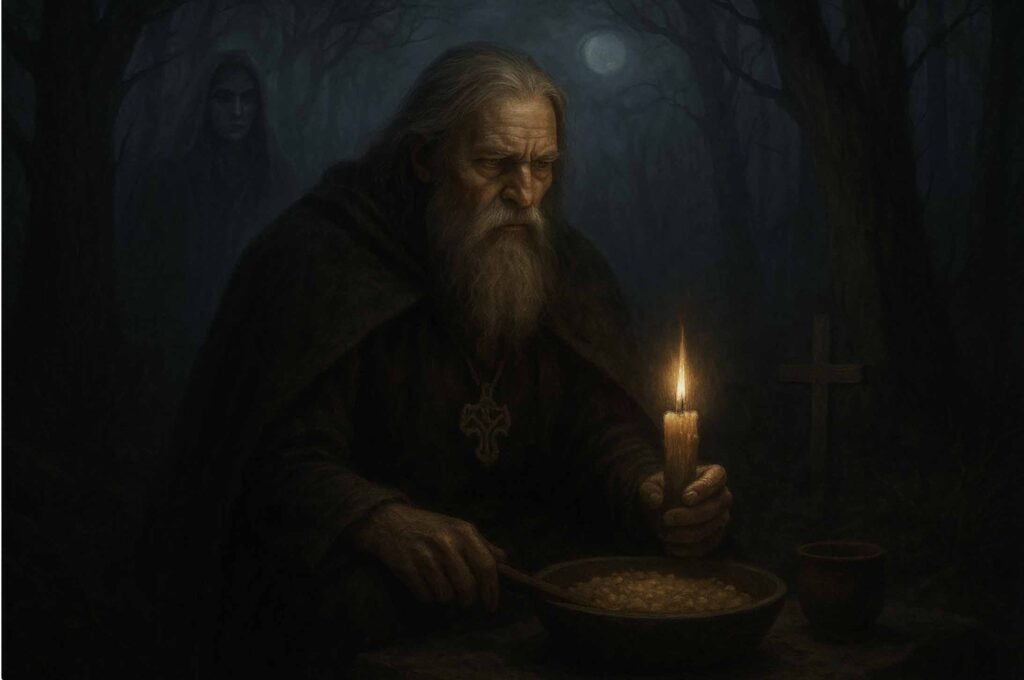
Culturally, this transition gave rise to ancestral rites — lighting candles, offering food, speaking softly to the dead. These acts weren’t morbid; they were bridges. November’s darkness was understood as a sacred pause — the thin moment when communication between worlds was possible, when the living could remember who they came from and what waits beyond.
Spiritually, November invites us into that same pause: to face our inner underworld, the unseen part of ourselves that thrives in silence. It’s the month when illumination doesn’t come from the sky but from within — from the small flame we carry into the dark.
- The idea that the dead are not absent — they are present in silence, in nature, and in our psyche.
In Slavic spirituality, death was never a full departure. The dead were not “gone” — they had simply crossed into a quieter dimension of the same world. Their presence lingered in the whisper of trees, the warmth of the hearth, the stillness before snowfall. The line between the living and the departed was porous; communication continued through ritual, memory, and dream.
Ancestors were seen as active participants in daily life. They were protectors of the household, guardians of fertility, and keepers of wisdom. Families would leave food or drink for them, whisper their names at dusk, or light candles during Zadushnice. These weren’t gestures of grief but acts of connection — acknowledging that the world of the dead sustains the living just as the roots sustain the tree.
Psychologically, this echoes a timeless truth: the dead live on within us. We carry their patterns, fears, talents, and unfinished stories in our unconscious — what Jung might call the ancestral layer of the psyche. When we dream of our grandparents, revisit family places, or sense déjà vu, we are touching that shared field.
The silence of the dead is not emptiness — it’s depth. It reminds us that memory and spirit are not lost to time, but transformed into the quiet background of existence. To listen to that silence is to remember that we, too, are part of a lineage that never really ends.
1. Veles – Guardian of the Underworld and Wisdom
- The pre-Christian god of earth, herds, death, and magic.
- His realm: misty, quiet, full of secrets and transformation.
- Connection to the animal instinct and the subconscious.
Zadushnice – The Christian Echo of Ancient Ancestral Rites
- Days of remembrance for the departed, especially the autumn Zadushnice (Mitrovdan period).
Veles, in the old Slavic pantheon, was the god of earth, cattle, death, and sorcery—a shapeshifting deity who ruled everything hidden, fertile, and mysterious. He stood as the eternal counterpart to Perun, the thunder god of the sky. While Perun governed order, law, and daylight, Veles reigned in the shadowed realms: the soil, the underworld, dreams, and the unconscious.
He was not a devil, though later Christian tradition painted him that way. To the pre-Christian Slavs, Veles embodied the living pulse of the underworld—the power that makes seeds sprout after burial, the wisdom born from decay, the wealth that comes from the earth itself. He was the patron of herdsmen and poets, of trade and trickery, of all those who dealt with the forces that slip between seen and unseen.
Veles could take many forms: a serpent coiling around the roots of the World Tree, a bear prowling the forest, or an old bearded man with the eyes of someone who has seen too much. His magic was not about domination but transformation. He guided souls after death, guarded the ancestral realm, and whispered to shamans in dreams.
In the Slavic imagination, to honor Veles was to respect the depth of life—the moist, dark, unpredictable part of existence where endings ferment into beginnings. He was the reminder that without the underworld, even the heavens would have nothing to stand on.
- Food, candles, and prayers as bridges between worlds.
In Slavic ancestral rites, food, candles, and prayers weren’t symbolic niceties — they were literal bridges between the living and the dead. Each gesture carried a function in maintaining harmony between worlds.
Food was an offering of continuity. Bread, grain, and wine — the fruits of the harvest — were shared with the ancestors as if inviting them to the table. The idea was simple and profound: what sustains us in this world sustains them in theirs. A portion of every feast was left for the unseen guests, acknowledging that life itself is communal, stretching beyond mortality.
Candles were lights of guidance. In the long, dark nights of late autumn, when the veil between worlds was believed to thin, the flame marked a path — both for the departed souls to find their way, and for the living to remember their inner light amid the surrounding dark. The candle’s flicker mirrored the fragile spark of consciousness that survives even in death.
Prayers were the voice that crossed the boundary. Spoken softly, often in silence or near the family hearth, they expressed gratitude and remembrance. Words were believed to vibrate through both realms, carrying emotion as energy. The prayer wasn’t a plea but a dialogue — the living calling into the stillness, and the stillness answering through intuition, dream, or inner peace.
Together, these acts form a pattern of reciprocity. Food nourishes, candles illuminate, prayers connect. The Slavs understood that to keep balance between life and death, one must feed not only the body, but the bond itself — the invisible thread that ties every living heart to the ancestral flame.
- The transformation of ancient ancestor veneration into a Christian ritual of remembrance.
When Christianity took root among the Slavs, it didn’t erase the old ways overnight—it absorbed and reshaped them. The reverence for ancestors, so central to pre-Christian Slavic life, quietly flowed beneath the new faith, transforming into the Christian Zadushnice and the commemorations of All Saints’ and All Souls’ Days.
Before conversion, families would gather at graves or crossroads to leave food, drink, and symbolic gifts for their dead. These weren’t mere offerings but acts of communion — affirmations that the dead still participated in the life of the family. When the Church arrived, it reinterpreted this exchange through its own theology: the feast became the memorial meal, the offerings became koljivo (boiled wheat with honey), and invocations to ancestors turned into prayers for the repose of souls.
The continuity is striking. The same gestures remain — lighting candles, sharing food, speaking names — but their purpose shifted from sustaining the dead in an unseen realm to interceding for them before God. The hearth became the altar; the family ritual became liturgy.
This blending of traditions reflects something deeply human: the need to maintain contact across the boundary of death. The Christianization of Slavic lands didn’t destroy the ancestral thread — it reframed it, giving it a new language while keeping its heart intact. Beneath every candle lit in a church still flickers the older flame — the one that once burned under the open sky, for the ancestors who remain close, just on the other side of silence.
- The closing of the cycle; the earth grows still, life retreats inward.
By November, the world has exhaled. The great movement of growth and harvest has ended, and nature folds back into itself. This is the closing of the cycle—the pause between what has been lived and what is yet to be born.
In the old Slavic rhythm, this stillness wasn’t seen as lifelessness, but as gestation. The earth does not die; it dreams. The fields, stripped of grain, begin their slow inward breathing. Trees pull their lifeblood down into their roots. Even the rivers grow sluggish, as if the land itself were meditating.
For the people who lived by these cycles, this was the season of turning inward as well. After months of labor, the pace slowed. Fires burned longer, stories replaced work, and silence gained a sacred texture. The outer world rested, inviting the inner world to awaken.
Psychologically, this mirrors the human need for renewal through rest — the descent into introspection before the next surge of creation. The Slavs understood that life must retreat to renew. What seems like stillness is in fact deep movement below the surface: the quiet alchemy by which the past decomposes into nourishment for the future.
In that sense, November teaches one of the oldest spiritual truths — that nothing truly ends; it only withdraws to prepare its return.
- In nature: decay and decomposition as necessary phases of renewal.
In Slavic spirituality, decay was never viewed as corruption or failure — it was the sacred labor of the earth. What falls must feed what rises. Every rotting leaf, every broken branch, every fading bloom was part of the invisible economy that sustains life.
The old Slavs saw this clearly in the forests that surrounded them: mushrooms bursting from fallen trunks, new shoots piercing through last year’s mulch, animals finding warmth in hollowed trees. The underworld of Veles was not a graveyard but a vast compost — a realm of transformation where the dead become the soil from which new life grows.
Modern ecology now confirms what ancient myth intuited: decomposition is not destruction but renewal through surrender. When matter breaks down, it releases energy, minerals, and fertility. When the old dies, the new has room to emerge.
Spiritually, this understanding runs deep. The soul, too, must undergo decay — the breaking down of rigid identities, old beliefs, and worn-out attachments. That inner decomposition is uncomfortable but necessary, for only what has been broken open can sprout something living.
So in November, as the air thickens with the scent of rot and wet leaves, nature is whispering an ancient truth: nothing wasted, nothing lost. The end is simply the beginning wearing a darker mask.
- In humans: introspection, self-examination, and silence.
For humans, November mirrors the movement of the earth — a turning inward, a gentle descent into silence. The outer light fades, inviting the inner one to flicker awake. In Slavic lands, this season was naturally contemplative: fields lay fallow, nights grew long, and the world itself seemed to ask for stillness.
In that stillness, introspection takes root. Just as the soil gathers the remnants of summer, the human psyche gathers the fragments of the year — memories, choices, unspoken emotions. The Slavs sensed that this was the time to sit by the fire, both literally and metaphorically, and look into the flames of one’s own heart.
Self-examination in this context isn’t judgment but honesty. It is a clearing of the inner field: seeing what has withered, what can be carried forward, and what must return to the soil. The act of remembering the ancestors parallels this — they are not only the dead we honor, but the parts of ourselves we must acknowledge and integrate.
And then comes silence — not emptiness, but fullness without noise. The kind of silence where thought gives way to awareness. It’s the psychic equivalent of winter soil — dark, quiet, but alive beneath the surface.
In the Slavic sense, this inner descent is not withdrawal from life but participation in its deeper rhythm. To listen inwardly during November is to align with the pulse of the world itself — the rhythm that says: rest now, so that when the light returns, it will find you ready.
November as a Symbolic Descent into the Underworld
In Slavic cosmology, November is not merely the dark end of autumn — it is a symbolic descent into the underworld, the sacred passage through shadow that precedes renewal. As the sun’s power wanes and the nights grow long, the visible world surrenders to invisibility. This descent mirrors both the mythic journey of the gods and the psychological journey of the soul.
In the old stories, Veles, the chthonic god, calls life downward. The cattle return to the barns, the sap to the roots, and the spirits of the ancestors to their resting places beneath the earth. The border between realms thins. To step into November was to step into Veles’s domain — the moist soil, the fog, the dreams. It was the season of whispers, of remembering that life and death share the same breath.
This underworld was not a place of torment, but of transformation. Just as seeds must first descend into darkness before sprouting, the soul must travel inward — through grief, uncertainty, and silence — to discover its hidden strength. The Slavs saw this descent not as loss but as initiation: every winter is a teacher, every darkness a womb.
Mythically, this echoes the pattern found across cultures — from Persephone’s descent to Jung’s nigredo, the black phase of alchemy where matter dissolves before rebirth. November, then, becomes more than a month; it is an archetypal movement. Nature, myth, and psyche all spiral into the same truth: one must go down to rise again.
To embrace November is to accept the invitation of the underworld — to walk willingly into the dim corridors of the self, carrying only a small flame of awareness, trusting that the way back to light begins in the dark.
The Jungian Shadow and the Inner Veles
- The Shadow as the archetype of the hidden and repressed parts of the psyche.
The Shadow, in Jungian terms, is the archetype that holds all that we deny, fear, or repress within ourselves — the impulses, desires, and instincts that the conscious ego rejects. It is not inherently evil or dark; rather, it is the raw, unrefined material of the psyche.
Symbolically, November’s descent mirrors this process. Just as nature withdraws its vitality into roots and soil, humans are invited to turn inward — to face what has been hidden beneath the surface. The Shadow emerges in dreams, projections, and emotional turbulence, demanding acknowledgment. Integration of the Shadow doesn’t mean indulgence in its darker urges, but rather recognition: to see it clearly without judgment.
In myth, this descent echoes journeys like Inanna’s to the underworld or Orpheus seeking Eurydice — each an encounter with loss, truth, and the unlit corners of being. The confrontation with the Shadow is always a form of death and rebirth — a shedding of falsity, making space for authenticity to emerge when light returns.
This inward movement is the psychic equivalent of winter’s stillness: nature decomposes, the soul contemplates, and from that decay, new growth waits quietly.
- A parallel to Veles, who rules over what is unseen and unacknowledged.
Exactly — Veles is a perfect mythic mirror of the Shadow. In Slavic mythology, he is the god of the underworld, cattle, wealth, and magic — but also of chaos, trickery, and transformation. He dwells beneath the roots of the World Tree, in the damp, fertile darkness where decay becomes renewal.
Veles opposes Perun, the thunder god of order and light. Yet their opposition is not absolute good versus evil; it’s a necessary polarity. Perun strikes from above, and Veles stirs from below. Together, they maintain the balance of the cosmos.
Psychologically, Veles represents the forces that dwell in the unconscious — the wild, the taboo, the creative, the erotic, the cunning — everything our conscious identity might disown but that still shapes us. Just as Veles guards hidden treasures in the earth, our Shadow guards psychic gold: repressed vitality, creativity, and truth.
To descend into Veles’ realm, symbolically speaking, is to face what we fear within ourselves — to traverse the mist and muck, meet the shapeshifter, and return with something essential. Without that descent, consciousness remains shallow and rigid, like a tree that refuses to grow roots into the dark soil that sustains it.
The mythic tension between Perun and Veles, like that between light and shadow, isn’t meant to be resolved but lived — as the rhythm of creation and dissolution, awareness and forgetting, life and its necessary darkness.
- Psychological meaning: encountering oneself through descent and reflection.
In psychological terms, descent and reflection mark the moment when consciousness turns inward — when the external light fades and the internal landscape begins to glow. It’s the symbolic journey down into the unconscious, where forgotten emotions, unlived desires, and old wounds wait like roots beneath the frost.
This descent isn’t a fall into despair but a ritual of truth-telling. To meet oneself in the depths means to face both the beautiful and the monstrous — to see how one’s fears, envy, longing, and sorrow all form part of a larger, living psyche. Reflection, then, becomes a kind of alchemy: the ego looks into the mirror of the unconscious and, if it dares not to turn away, discovers its own transformation beginning.
Just as in nature winter draws energy inward to restore life, psychologically this inward movement renews the soul. Through descent and reflection, one doesn’t escape darkness — one learns to breathe within it.
The Candle’s Flame as a Symbol of Consciousness
- A candle lit for the ancestors as a metaphor for awareness illuminating the darkness.
A candle lit for the ancestors is both an offering and a revelation. Its small flame mirrors the act of consciousness itself — fragile, flickering, yet able to push back vast shadows. In Slavic tradition, the candle bridges worlds: the living light the way for the departed, while the dead, in turn, remind the living of where they came from and what still burns within them.
Psychologically, this gesture translates into awareness. To light a candle is to bring attention to what has been forgotten — the ancestral memories, the emotional patterns, the unspoken griefs carried through generations. The flame becomes an eye that sees into darkness without fear.
Each candlelit moment is thus a quiet initiation: illumination not by the brilliance of day, but by the steady glow of presence — consciousness warming the cold terrain of the unconscious.
- Every spark of consciousness reveals part of the unconscious — a fragment of those who came before us.
Every spark of consciousness is like a torch passed through time — it carries the memory of countless lives that shaped our inner landscape. When we become aware of something hidden within ourselves, we’re not just discovering a personal truth; we’re touching an ancient lineage of experience that still moves through us.
In Jungian terms, this is the collective unconscious stirring — the ancestral psyche surfacing through dreams, symbols, and intuitions. Each insight we gain is a fragment of those who came before us, rising into awareness to be seen, honored, and integrated.
Awakening, then, is not solitary. It’s a dialogue across generations — light speaking to darkness, the living listening to the dead, and the self remembering it has roots that reach far beneath the soil of the present moment.
Conclusion:
- November as a time of reconciliation with the past and the inner night.
November stands as a quiet threshold — a month when the world exhales and the veil between seen and unseen thins. It’s not just the fading of light, but an invitation to reconcile with what lies behind us and within us. The fallen leaves and bare trees mirror the psyche stripped of its disguises, asking us to face what we’ve buried.
Reconciliation here means more than forgiveness; it’s an act of integration. The past — with its regrets, losses, and unresolved stories — is not an enemy to escape but a companion to understand. The “inner night” is the place where those memories dwell, waiting for acknowledgment.
When we sit in that darkness without rushing to relight the sun, something sacred occurs: peace begins to form, not from denial but from acceptance. November teaches that harmony is born not in perpetual light, but in the courage to meet one’s own shadow and let it rest beside the self.
- Veles and the Shadow both invite wisdom rather than fear.
Veles and the Shadow both dwell in the underworld — not as forces of evil, but as guardians of depth and truth. In Slavic cosmology, Veles rules over the unseen: the realm of ancestors, dreams, and transformation. In Jungian psychology, the Shadow holds what consciousness has denied — instincts, emotions, and forgotten parts of the soul.
Both invite wisdom rather than fear because they demand honesty. Veles lures the hero off the sunlit path into the forest of the unknown; the Shadow does the same within. What they offer is initiation — the knowledge that wholeness comes only when light and darkness meet without judgment.
To reject them is to remain divided. To listen is to grow roots. In facing what is hidden, one learns that the underworld is not a punishment — it is a teacher.
- The return of light through understanding darkness — this is the essence of Slavic alchemy.
The return of light through understanding darkness is the heart of Slavic alchemy — not the transformation of metals, but of the soul. In ancient lore, the world’s rhythm was never a battle between good and evil, but a dance between day and night, Perun and Veles, life and decay. Harmony came not from conquest, but from balance.
To “understand darkness” meant entering it with awareness — walking through grief, memory, and silence until meaning emerged like dawn through mist. This is the alchemy of consciousness: turning shadow into insight, loss into wisdom, mortality into reverence for life.
When the Slavs lit candles in the depth of November, they were performing a sacred experiment in light — not banishing the dark, but illuminating it from within. That gentle glow, born from acceptance, was their philosopher’s stone.